The other week, whilst visiting my family in Rome, I watched one of my favourite films: "Sabrina" (1954) with Audrey Hepburn and Humphrey Bogart. I couldn't help thinking how much more I preferred the 1954 version better than the remake in 1995 with Harrison Ford and Julia Ormond- probably because Audrey Hepburn and Bogart just ooze class and are on different levels from Ford and Ormond, but also I am always weary of remakes of films and songs etc and have always believed that the original is the best. So, with the recent release of "The amazing Spiderman" (2012) so close to the Sam Raimi version with Tobey Maguire and Kristen Dunst, it got me thinking about how fast the turnover of similar, or a exact reproduction of the same film is distributed to the public. One benefit of these 'copies' (as they can be called I suppose) is that the audience get to see the different ways that various directors and producers adapt the same narrative. Who knows...maybe Andrew Garfield, the new Spiderman, embodies the role of the well known superhero much better than Tobey Maguire. I haven't seen the film and so am yet to judge.
Moving on, talking about remakes, the other week I watched the critically acclaimed "High Society" (1956). Safe to say, there could hardly be any room for error with Bing Crosby, Frank Sinatra, Grace Kelly and Louis Armstrong as the cast members. But as the film progressed, I slowly realised that I recognised the story, almost word for word: an upper class woman, who had been previously married to a childhood friend, about to be remarried to a self-made man, and a journalist and photographer who are both trying to get-the-scoop on the wealthy socialites wedding. After some searching it came to me, "High Society" was a remake of "The Philadelphia story" (1940), another favourite, starring Katherine Hepburn and Cary Grant.
"The Philadelphia story" (1940), directed by George Cukor, is based on the broadway play written by Philip Barry. Barry originally wrote the main character, the socialite Tracey Lord, for Katherine Hepburn herself and the role suits her perfectly. The film is a classic example of the screwball comedy of the 30s and 40s. The film proves once again that the Katharine Hepburn-Grant duo can not be separated on the silver screen; not even by the charming James Stewart who plays the journalist, Macaulay Collins, who also falls in love with the socialite. Stewart uses fiery poetry to try to enchant Hepburn in the scene below:
"High Society" is the musical version of Barry's play and "The Philadelphia story", directed by Charles Waters. The film incorporates the popular songs of Cole Porter, such as "Well, did you evah! (what a swell party this is)" and "Who wants to be a millionaire?"sung by the cast members. In addition, the actors endorse the elegant fashion in the same way as the characters in "The Philadelphia story", but one can see the shift in iconic style from the 40s to the 50s- not just in the fashion but also in the grandeur of the mansions. There are some critics who claim that Grace Kelly mimicks Katherine Hepburns' take on the character far too much; but Grace Kelly, coming from a high society background herself, knows very well the airs and graces of a woman with money. A scene from "High Society" is shown in the clip below. Frank Sinatra plays the same character that James Stewart played in "The Philadelphia story". Instead of poetry, Sinatra uses his voice to sing the bewitching "You're sensational" to win Kelly over:
Both scenes are well performed and directed in their own right. Watching both films, it is clear that Charles Waters took Philip Barrys' narrative and added his own touches to this fantastic love story- that has been (and still is) repeated and/or adapted in the rom-coms of today. In addition "High Society" was Grace Kellys' final film before she became the Princess of Monaco, and this also added to the films success. Both films were distributed by MGM but, unlike the two productions of "Sabrina" where I could clearly distinguish which version I preferred, it seems to be more difficult to choose a favourite between "The philadelphia story" and "High Society". Using just the two scenes above it seems to be a choice between James Stewart reciting poetry and Sinatra admiring you and calling you 'sensational'- and I can't seem to choose! With both films being alluring for different reasons it becomes clear why they were advertised as two separate films in the first place.
The commercial success of "The Philadelphia story" and "High Society" highlights why producers and directors will continue to remake films with the same narrative- and it's not only because they can take money from a new generation who might not have heard of the original story. Narratives can be restyled and refreshed by adding different musical scores, lines adjusted by new witty scripts and changing the lineup with current celebrities of the time, not to mention improved graphics with new technology. Thus who knows...maybe fans of the old Spiderman movies will also become fans of the new "The amazing Spiderman" (2012) and appreciate both films in their own right; after all, it's just a bit of history repeating.
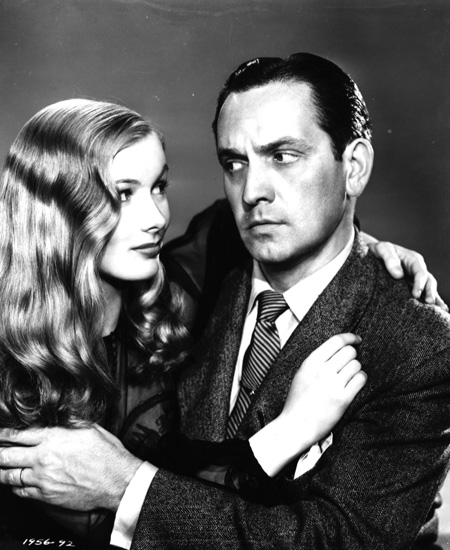
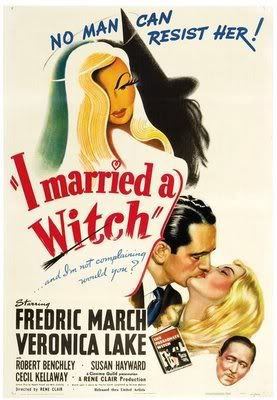
Moving back in time now from the sci-fi of the 1950's to the pre-war magical innocence of the 'screwball comedy' and an analysis of the brilliantly whimsical film, "I married a witch" (1942) with Veronica Lake, and Fredric March. Directed by René Clair.
The screwball comedy
The screwball comedy has been described as "the sex comedy without sex", but it proves that the ripping off of the protagonists clothes is not a necessary ingredient to create entertaining films. The genre came as the rigid, censorial production code of the 1930s put an end to topics such as adultery, homosexuality, and drugs being openly addressed on the silver screen. The term 'screwball' was invented by the pitcher Carl Hubbell in the 1930's. "It's a pitch with a particular spin that flutters and drops, goes in different directions, and behaves in very unexpected ways" and the 'screwball' films work in exactly the same way: they are unbalanced, erratic, irrational and unconventional.
The films are built upon a sarcastic and witty script with humour driven at the ritualistic humiliation of the male. It is predominantly a female genre, containing an eccentric heroine who saves an anti heroic man from a rigid lifestyle; satirical targets are usually men who work in the law or journalism so their intelligence can be criticised. The great depression and the transition from silent to sound film fuelled the popularity of the 'screwball' genre with an increased fascination of the upper class way of life. The new 'talkies' allowed witty verbal interaction between the protagonists; all which contributes to the farcical battle of the sexes. On the screwball comedy James Arge states:
"It's nuts, it's illogical, it's impossible, and it's hilarious. It's also abundant with endless comic variations, opened to unexpected situations, and primarily grounded in danger."
This film is a perfect example of a 'screwball' comedy but with an added twist: using witchcraft as another way to humiliate the male. Jennifer (Veronica Lake) and her father Daniel (Cecil Kellaway) are burned at the stake by the puritan Johnathn Wooley (Fredric March) who buries their ashes under an oak tree to imprison their evil spirits. Jennifer puts a curse on the Wooley men and their successors so that any marriage that a Wooley man enters into will be doomed. Time fasts forward to 1942, when lightening strikes the oak tree and the ghost spirits of Jennifer and Daniel are released ready to get revenge on Wallace Wooley (also played by March) and ruin his arranged marriage with his fiancé Estelle Masterson (Susan Hayward).
The film was produced by Paramount pictures but released on the 30th October 1942 by United Artists. Although there is on screen chemistry between Lake and March in reality they didn't get along. Pre-production, March said Lake was "a brainless sex-pot, void of any acting capability" to which Lake replied that March was a "pompous poser": and so, the games begin.
In the opening credits one can hear the wedding theme in the musical score by Roy Webb, hinting on what is to come. The film begins with the burning of Jen and her father at the stake but the scene is made comical by announcing an intermission within the film making reference to the fact that it is a film 'show' and not reality. Then comes the montage, which provides a perfect overview to the Wooley family problems over the succeeding generations. This montage shapes the romantic story or anti-romantic story as it shows the curse in action when the Wooley man would prefer to go to fight in the civil war of 1861 than stay with his wife.
Ironically as Wooley is making a speech about "a new...beginning", lightening strikes the oak tree. Although all the audience can see are two clouds of smoke, the essence of the screwball wit is still present as Jennifer states she wishes she had: "lips to whisper lies, lips to kiss a man and make him suffer." Dark: but then a man did burn her at the stake. Jennifer is not seen in body form until her father sets fire to the purposely named Pilgrim Hotel and Wooley has a strange inclination to go inside to 'save' her. This scene switches from being feminist to slightly chauvinist. Although Jennifer does lure in Wooley with her voice, she waits for him to save her and carry her out showing her as a typical damsel in distress. She seems satisfied with her new body but questions Wooley "would you have preferred me brunette?"
Lake is highly sexualised throughout the film by showing her wearing just a coat sitting with her legs on full show or wearing Wooley's pyjamas. She asks countless times whether Wooley finds her attractive, highlighting that she still wants to please her man. She comes out with witty line after witty line, sliding up and down banisters emphasising a sexual innuendo and comically speeds up time when Wooley is giving a long, dull speech on the meaning of true love. However as the film progresses Jennifer seems to lose her authority over Wooley, especially after she drinks the love potion and actually falls in love with him.
In the final scenes there is screwball irrationality and mayhem: Wooley is trying to get married but keeps getting interrupted by Jennifers' father Daniel who is trying to get his long awaited revenge on the Wooley family; Jennifer is begging her father not to frame Wooley for murder; Estelle (Hayworth) is trying to get married to Wooley and having to walk down the aisle several times before eventually giving up; Daniel gets arrested for drunken behaviour; and to top it all off theres a wedding singer screeching the beginning of "I love you truly" repeatedly. Awkward, to say the least, and the audience is left wondering whether anybody will get married. Yet, true to screwball fashion, Jennifer does marry Wooley in the end and uses her witchcraft to help further Wooley's career. They have two children, a boy who resembles Wooley and a little girl resembling Lake.
"So my wife's a witch, every man has to make some adjustments."
"I married a witch" (1942) may have been Sol Saks' inspiration for "Bewitched" (1964-72) TV series, but this fact still remains unclear. However this series was one of my favourite growing up: they used to play re-runs on channel 4 on Friday mornings and I could watch the episodes again and again.
Not only does the witch, Samantha (Elizabeth Montgomery), have the flowing blonde hair and the deep blue eyes of Veronica Lake but she also doesn't tell her husband, Darrin (played by Dick York 1964-68 and then Dick Sargent 1969-72) that she is a witch until after the marriage ceremony following which the hilarious battle of the sexes begins again, for 8 full seasons. "Bewitched" is a televised representation of the screwball comedy. By the 1960s feminist ideals were becoming more popular but most television shows still had idealised family values and so underwent harsh censorship. Saying this, "Bewitched" is the perfect example for showing these new male fears about women's changing sexuality and evolution of domestic institutions in a subtle way. Samantha is the doting housewife with the 'adjustable' husband who tries to lead a life without witchcraft but with a witty edge:
Darrin: "First your my wife, then you're a witch, and a wives' place is with her husband."
Samantha: "Oh good. I guess that means you want me to play golf with you this afternoon."
The series started out as success, but after a long run ratings dropped as production started to use cheaper looking sets and recycled scripts. In addition many actors were changed and replaced:
"with two Darrins', two Louises', two Gladyses', and ten Tabithas, fans of Bewitched prove to be a tolerant lot. only time will tell if they will ever be able to accept another Samantha..."
~ http://harpiesbizarre.com/tabstory.htm
And alas, they definitely didn't with Nicole Kidman in "Bewitched" (2005). But a strong message that both "I married a witch" (1942) and the "Bewitched" TV series portray is that:
So natural (earthly) order is restored, for a while. Coincidentally, as I was researching for this blog entry I found that someone on youtube has combined pictures taken from "I married a witch" and "Bewitched" and put them over the song Witchcraft performed by Frank Sinatra. Brilliant: